TL;DR
- The first 10 seconds after an incident decide whether the situation calms down or escalates.
- 4 steps, always in this order: safety → name the aggressor’s emotion → attend to the hurt child in front of the aggressor → a natural consequence, not a punishment.
- Separate age boxes — 2-3 (biting) and 4-5 (hitting, pushing) — because the protocol looks slightly different depending on age and your child’s vocabulary.
- This is a normal developmental phase, not a sign something is “wrong” with your child.
- Repeated incidents are a signal to change something in the environment or routine, not to escalate the consequence.
She bit a classmate at daycare. He punched you because you said “no” to a second episode. He pushed another boy waiting in line for the slide. You’re standing there with a split second to react and a head full of questions: apologize for your child? Punish? Ignore it? Below is a ready-made protocol for those first, critical 10 seconds — split by age (2-3 and 4-5), with a full word-for-word script.
Why young children bite, hit, and push
Children ages 2-5 still have an immature impulse-control system — the emotion (anger, frustration, overstimulation) shows up faster than their ability to stop it with words. Biting, hitting, or pushing is often the first “language” available for a strong emotion, before your child has the words to name it.
Research tracking the trajectory of physical aggression in young children shows that its frequency peaks around age 2 and, for most children, steadily declines as language and self-regulation develop — so a single incident isn’t a sign of a lasting problem (Tremblay et al., 2004).
The first-10-seconds protocol
The first 10 seconds after an incident decide whether the situation calms down or escalates. Four steps, always in this order: safety, naming the emotion, attending to the hurt child in front of the aggressor, and a natural consequence — not a punishment.
Ages 2-3 — script: biting at daycare
At daycare, the most common trigger for biting is a fight over a toy or a spot, not malice — your child reaches for their teeth because they don’t have words faster than the impulse yet. Below is the full word-for-word script for this exact situation.
Situation: two children reach for the same toy car. One of them bites the other on the arm.
- Safety — separate the children. You slide your hand between them, physically separate them. “I’m stepping in here — no biting right now.”
- Name the aggressor’s emotion. You crouch down next to the child who bit, make eye contact. “You really wanted that car. That’s anger, because someone took it from you.”
- Attend to the hurt child in front of the aggressor. You turn to the bitten child, loud enough for the aggressor to hear. “Show me your arm. A cold compress will help.” (you apply the compress, the aggressor watches the whole interaction)
- Natural consequence — not a punishment. To the aggressor: “Teeth are for eating, not for anger. The car is being put away for now — nobody gets it until you’ve both calmed down.”
Ages 4-5 — script: your child hits you at home
At this age, hitting a parent most often shows up as a reaction to being told no — your child has more words by now, but at the peak of anger their body still reacts faster than their sentence. The script below shows how to stop the hand while also modeling your own boundary.
Situation: your child punches you in the leg out of anger, because you said “no” to a second episode.
- Safety. You gently catch your child’s wrist before another hit lands. “I’m stopping your hand — you won’t hit me.”
- Name the emotion. Still holding the wrist, in a calm voice. “You’re furious that there’s no second episode today.”
- Attend to the hurt party in front of the aggressor (here: yourself, in front of your child). “Being hit hurt me. I need a moment.” — you show that you too have boundaries and feelings, modeling the response.
- Natural consequence. “When you’re angry, you can say it in words, or hit the cushion on the couch. You may not hit me — we’ll talk once you’ve calmed down.”
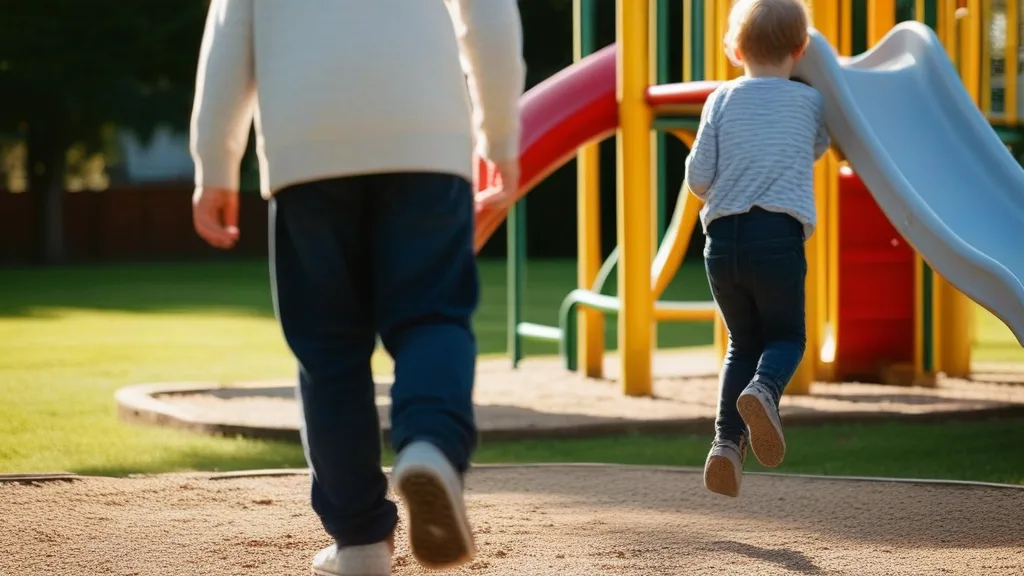
Script: pushing at the playground (ages 4-5)
Pushing at the playground most often comes from a conflict over turn-taking or space, not a wish to hurt — your child is defending their spot in line the only way that comes to mind in the moment. The same four-step protocol works here too.
Situation: your child is waiting in line for the slide, another child cuts in, and your child pushes them.
- Safety. You step in, position yourself between the children. “I’m calling a pause here — both of you take a step back.”
- Name the emotion. To your child. “You got upset that someone cut in front of you.”
- Attend to the hurt child in front of the aggressor. To the other child, loud enough for yours to hear. “Are you okay? That push might have startled you.”
- Natural consequence. To your child. “You can wait in line like everyone else, or go play somewhere else until you’ve calmed down. Pushing doesn’t move the line faster.”
When it keeps happening
A single incident is usually just a moment of overload; a repeating pattern (same time of day, same child, same trigger) signals something to change in the environment or routine, not a reason to escalate the consequence. Track for a week when incidents happen — the pattern usually shows itself.
The most common patterns worth watching for:
- Time of day: incidents clustered right before a meal or nap (hunger, tiredness) call for a schedule change, not a longer talk.
- Location: repeated incidents in the same corner of a room or playground can point to too little space or too much stimulation in one spot.
- Person: if incidents keep involving the same pair of children, temporarily separating their spots (table, cot) for a few days — not permanently — can help.
How to prevent it
Most incidents are predictable: tiredness, hunger, overstimulation, and too little personal space are the most common triggers. A short list of warning signs and simple environment changes reduces the number of incidents more than reacting after the fact.
- Warning signs to catch early: clenched fists, a louder voice, shifting weight foot to foot, a “checked-out” stare right before the outburst.
- More physical space between children in tight spots (table, rug, line) — just increasing the distance lowers the number of incidents.
- Announcing transitions ahead of time (“we’re finishing up in two minutes”) instead of a sudden change — less surprise, less frustration.
- Access to a “safe outlet” for anger — a cushion to hit, a bit of play dough to squeeze — before the emotion peaks.
Why this works
This protocol is a response to an incident that has already happened — it doesn’t cover the broader philosophy of discipline without punishments and rewards, or what to do when your child loses it purely from frustration (not aggression). We cover both of those separately.
Discipline Without Punishment: How Is That Even Possible? explains the mechanism behind the natural consequence in step 4 above. What to Say When Your Child Throws Their Crayons and Says They Give Up covers a related situation — an older child (ages 4-9) who isn’t attacking anyone, just giving up out of frustration. And if you’re wondering why a 2- or 3-year-old says “no” to everything and pushes back even outside physical incidents, we cover the broader developmental picture in Toddler Rebellion in Practice.
Sources
- Tremblay, R. E., Nagin, D. S., Séguin, J. R., Zoccolillo, M., Zelazo, P. D., Boivin, M., Pérusse, D., & Japel, C. (2004). “Physical aggression during early childhood: Trajectories and predictors.” Pediatrics, 114(1), e43–e50. A study tracking trajectories of physical aggression in young children — frequency peaks around age 2 and declines for most children as language and self-regulation develop.
- Siegel, D. J., & Bryson, T. P. (2011). The Whole-Brain Child: 12 Revolutionary Strategies to Nurture Your Child’s Developing Mind. Bantam. The “name it to tame it” technique — naming an emotion out loud helps a child regulate it, used in step 2 of the protocol.
Biting, hitting, or pushing at this age is usually overload, not ill will. A consistent protocol — safety, naming the emotion, attending to the hurt child, a natural consequence — teaches your child more than a one-off punishment ever could. At Dzieckologia we write about tested, everyday ways to handle situations like this — check out the Practical pillar for more scripts.
Author
Dzieckologia Team
Tags:
Like this topic?
🏠 Browse all "Practical life" articles