TL;DR
- Toddler rebellion isn’t spite — it’s a stage of building autonomy, where your child tests where their influence over the world ends.
- “No” is often an automatic response, unrelated to the actual content of the question — sometimes offering a real, limited choice is all it takes.
- Four everyday scenes (getting dressed, breakfast, leaving the house, picking a toy) show the same mechanism playing out in different places.
- A limited choice (two options you’re both okay with) defuses most standoffs without a fight for control.
- It usually resolves on its own as language and self-regulation develop — rarely needs professional intervention.
Monday, 7:12 AM. A bowl of oatmeal on the table. “I don’t want that cup.” You swap the cup. “I don’t want the oatmeal.” Five minutes later, the same child happily eats… the same oatmeal, out of a different cup. Sound familiar? Welcome to the club of parents raising a 2- or 3-year-old, where “no” comes up more often than “yes” — sometimes even when your child just got exactly what they wanted.
Why does a 2- or 3-year-old say no to everything
Between roughly 18 months and age 3, your child is intensely building a sense of autonomy — learning that they have a will of their own, separate from yours. “No” is the simplest, fastest tool available to test that.
It isn’t stubbornness aimed at you personally; it’s practice at being a separate person.
Erik Erikson (1950) described this stage as the crisis of “autonomy versus shame and doubt” — the main developmental task at this age is finding out whether your child can make their own decisions without losing your closeness and love. “No” is the fastest word available to test that — often before your child has even had time to consider whether they actually don’t want something.
Normal (though exhausting) versus worth a closer look
Most 2-3-year-old rebellion falls well within the normal developmental range. The table below helps you tell everyday, tiring “no”s apart from signals worth paying closer attention to.
| Normal (though exhausting) | Worth a closer look |
|---|---|
| ”No” as the first, automatic reaction to almost every question | Rebellion stays just as intense past age 4 |
| Changing their mind a minute after refusing | Regular physical aggression toward self or others, unrelated to any specific situation |
| Rebellion gets stronger with tiredness, hunger, or an audience (grandparents, a store) | Your child doesn’t settle back down even after extended calming attempts |
| Short bursts of frustration (a few minutes) that pass on their own | Rebellion appears alongside a clear loss of previously acquired skills (speech, independence) |
A day in the life: 4 rebellion scenes and what to do
Below are four typical situations from one day — with a word-for-word script, a short “what’s happening developmentally” note, and a concrete “what to say/do” tip.
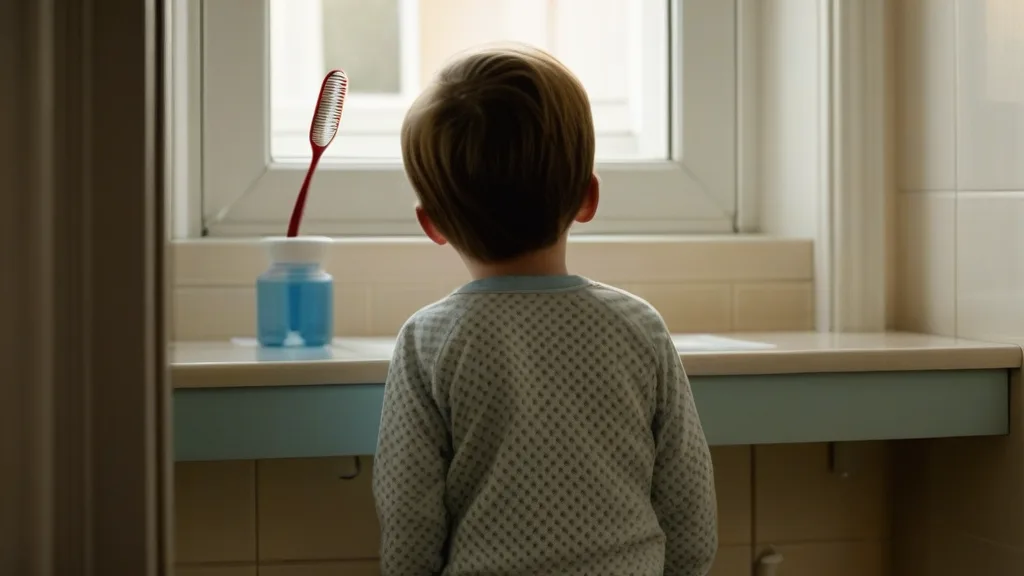
Scene 1: Getting dressed in the morning
It’s 7:15 AM, fifteen minutes until you need to leave.
Parent: “Let’s put on this shirt, it’s getting chilly.” Child: “NO! Not that one!” Parent: (crouches down, holds up two shirts) “Okay — the polka dot one or the striped one?” Child: “…polka dot.” (takes the shirt but grumbles while putting it on) Parent: “I can see it’s still hard, even though you picked it yourself. Want help with the sleeve?” Child: “Yeah.”
What’s happening developmentally: the first suggestion got rejected automatically — not because the shirt was wrong, but because the question came from outside. A choice between two options shifts the decision to your child without actually changing the outcome (the shirt still goes on).
What to say/do: always have two options you’re okay with ready before you ask an open-ended question like “what do you want to wear today?”
Scene 2: Breakfast
Oatmeal on the table, time is tight.
Child: “I don’t want that cup!” Parent: “Okay. Red one or yellow one?” Child: “Yellow!” (takes the cup, then) “I don’t want the oatmeal!” Parent: (doesn’t change the meal, crouches at the table) “I hear you don’t feel like it today. I’ll leave it here another five minutes before I clear it away.” Child: (after a moment, without comment, starts eating)
What’s happening developmentally: refusing food is often a test of control, not genuine lack of hunger; pressure (“just eat it!”) often increases resistance because it raises the stakes of the standoff.
What to say/do: don’t negotiate the meal itself endlessly — give a time window and a natural boundary, with no punishment and no begging.
Scene 3: Leaving the house
You need to run an errand and your child is mid-play.
Parent: “Let’s put on your jacket, we’re going to the store.” Child: “I’M NOT GOING!” Parent: (crouches, eye contact) “I hear you’d rather stay home. I sometimes want to stay home too. We do need to go today — do you want to get in the car by yourself, or should I help?” Child: “By myself!” (walks over, still grumbling, but walks)
What’s happening developmentally: naming the feeling before stating the decision lowers resistance — your child feels heard before they hear “we have to.”
What to say/do: name the feeling before you give the decision; don’t ask “do you want to go?” when “no” isn’t actually an option you’re weighing.
Scene 4: Picking a toy
At the toy store, your child wants two things at once.
Child: “I want this ONE and this ONE!” Parent: “Today we’re picking one. Which one do you want the most?” Child: “BOTH!” Parent: (waits, doesn’t budge) “I know it’s hard to choose when they’re both cool. You have a moment to decide, or I’ll decide for you.” Child: (after a moment, tearing up) “…this one.” (points to one) Parent: “Good choice. We can add the other one to your birthday list.”
What’s happening developmentally: a boundary held calmly, without endless negotiation, teaches that emotions — even tears — don’t change the boundary itself; they only change how it gets communicated.
What to say/do: hold the boundary, validate the emotion, offer a real alternative (like a birthday list) instead of an empty promise.
How long this lasts, and when it’s actually worth worrying
The most intense phase usually falls between about 18 months and age 3, and gradually eases as language and the ability to wait develop — for most children it noticeably fades by their 4th birthday.
If rebellion isn’t easing after that age and is instead building alongside regular aggression, it’s worth checking in with a pediatrician.
Harvey Karp (2004), in The Happiest Toddler on the Block, describes a young child at this age as operating more on emotion than on logic — you first need to “speak to the emotion” (name what your child is feeling, briefly and with emphasis) before any logical argument has a chance of landing. That’s why verbal negotiation rarely works mid-meltdown, and naming the feeling — as in the scenes above — works almost every time as the first step.
What comes next, when rebellion turns into something more
Sometimes that same “no” turns into biting, hitting, or pushing — a different, more urgent scenario with its own safety-first protocol.
We cover it separately, step by step: When Your Child Bites, Hits, or Pushes. If you’re looking for a general technique to get your child to actually hear an instruction the first time (not just mid-rebellion), start with My Child Doesn’t Listen — How to Get Them to Listen the First Time, and for a ready-made phrase bank to replace “no” and “stop,” see What to Say Instead of “No” and “Stop”.
Sources
- Erikson, E. H. (1950). Childhood and Society. W.W. Norton & Company. The “autonomy versus shame and doubt” stage (roughly 18 months–3 years) as the developmental source of a child’s need to test their own will.
- Karp, H. (2004). The Happiest Toddler on the Block. Bantam. The technique of naming an emotion before moving to rational conversation, as the first step in de-escalating a young child’s rebellion.
A 2- or 3-year-old’s “no” is usually practice at being a separate person, not an attack on your authority. A limited choice, naming the emotion, and a calm boundary defuse most standoffs faster than persuasion does. At Dzieckologia we write about tested, everyday ways to handle situations like this — check out the Practical pillar for more scripts.
Author
Dzieckologia Team
Tags:
Like this topic?
🏠 Browse all "Practical life" articles