TL;DR
- Two separate activities, two separate “resistance → script” tables — brushing teeth and bath time are different physical contexts with different resistance and different responses.
- The “limited choice” frame — two controlled options instead of an open question that always ends in “no.”
- Bath refusal = an everyday power struggle for control, not a fear of water — an important distinction, because it calls for a different response.
- We’ve already covered getting dressed elsewhere — just a short link here so we don’t repeat that article.
- Scripts for right now, not a weeks-long system — if you’re looking for a broader morning routine, this article isn’t a replacement for that.
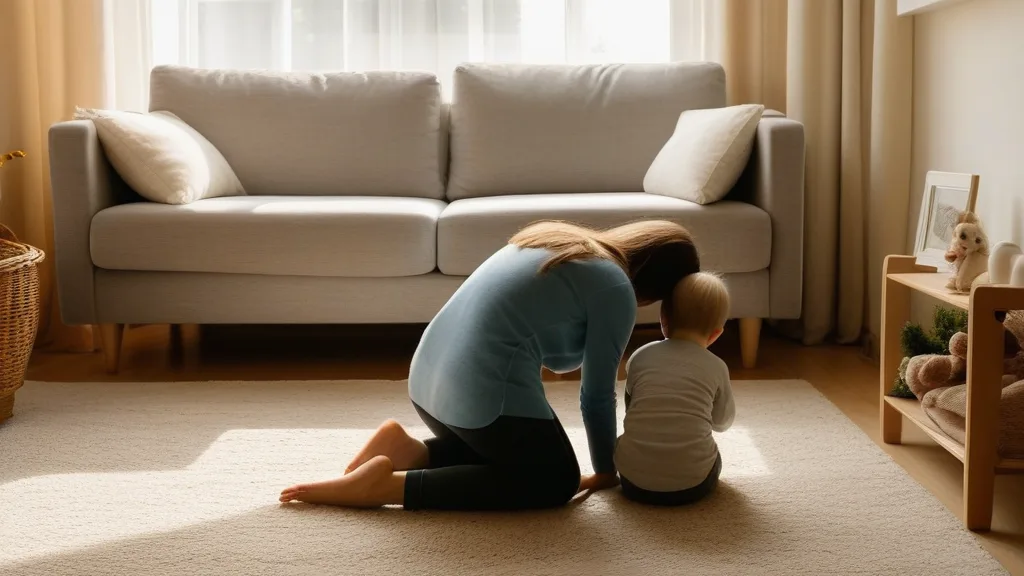
They clamp their lips shut and turn their head the second you walk over with the toothbrush. They scream “no!” before you’ve even started running the bath water. The same fight, every day, over two things that have to happen no matter how much your child protests. Below are ready-made scripts for those exact moments — what to say in the second your child says no, at the sink and in the tub.
Why your child re-fights brushing teeth and bath time every single day
Brushing teeth and bath time are two of the last moments in the day where your child has almost no real control — someone else decides when, how long, and with what.
At ages 2-5 the need for autonomy is strong, and these two activities routinely don’t give any, so the protest comes back every day, even after a good day yesterday.
This isn’t about a missing skill (your child can already open their mouth and step into the tub) — it’s a daily test of how much control you’ll leave them today. That’s why the scripts below don’t teach “how to brush teeth” — they give your child a real, limited choice in the exact moment they refuse.
Brushing teeth: resistance → script
The most common resistance at the sink is clamped lips, running out of the bathroom, or crying “it hurts!” — each one needs a different, short response in that same second, not a longer conversation.
| What your child does | Script |
|---|---|
| Clamps their lips shut, turns their head | ”I can see you don’t feel like the toothbrush right now. Let’s just do the top teeth, okay?” |
| Runs out of the bathroom | ”I’ll wait right here until you come back. Teeth can wait two minutes — not all night.” |
| Cries “it hurts!" | "Let me check if the brush is too hard. Let’s try the soft one — look.” |
| Bites the toothbrush instead of brushing | ”You can chew on it for a second, then we switch — I brush, you keep time.” |
| Screams “I don’t want to!” at the mere mention | ”I hear you, you don’t feel like it. Do you want to start with the top or the bottom?” |
Scenario: clamped lips right before bed
Situation: your child is standing at the sink, sees the toothbrush in your hand, and clamps their lips shut before you’ve said a word.
Parent: “I can see you don’t feel like the toothbrush tonight.” Child: (turns their head away, says nothing) Parent: “Do you want to brush the top teeth or the bottom teeth first?” Child: “Neither!” Parent: “Okay, let’s do it differently — I’ll count to three brush-strokes, then we switch and you check if I did mine right. Ready?” Child: (opens their mouth reluctantly — but opens it)
Bath time: resistance → script (everyday protest, not fear)
Resistance in the bath looks different from resistance at the sink — it involves the whole body, so the response needs to give your child more physical control over the pace of getting in and out.
| What your child does | Script |
|---|---|
| Refuses to get in the tub | ”I can see you don’t feel like it today. Do you want to step in yourself, or should I help with the first step?” |
| Screams during hair-washing | ”We’ll cover your eyes together, same as always. I’ll count to five and we’re done.” |
| Won’t get out of the tub | ”I already set the timer — when it rings, we’re out. Two more minutes of play.” |
| Throws toys out of protest | ”Toys stay in the water, they don’t fly through the air. You can put them away, or I will.” |
| Says “I hate baths!” every day | ”I hear you. Tonight let’s just wash your legs and hands at the sink — maybe that’s easier.” |
Scenario: “I don’t want to get in the tub”
Situation: the water’s already run, and your child is standing in the bathroom doorway shaking their head.
Parent: (crouches by the tub, at eye level with the child) “I can see you don’t feel like getting in tonight.” Child: “No! I hate baths!” Parent: “I hear you. Do you want to step in yourself, or should I help with the first step in?” Child: (stares at the water, says nothing) Parent: “I’ll give you ten more seconds to decide, and then I’ll choose for us — we go in together, holding hands.” Child: (steps in on their own, holding the edge of the tub)
The “limited choice” frame: two options, not an open question
Asking “do you want to brush your teeth?” always ends in “no,” because it leaves your child a choice about whether to do it at all.
Two concrete options move the question from “whether” to “how” — your child still gets to decide, but within limits that lead to brushed teeth either way. Ready-made pairs for teeth: “top or bottom first?”, “standing or sitting on the tub edge?”, “counting to ten or a song?” Ready-made pairs for the bath: “sponge or cup?”, “warm or slightly cooler water to start?”, “get in yourself or with my hand?” The rule is always the same — both options need to be equally acceptable to you, because your child will pick the one you didn’t expect.
When it’s not everyday resistance, but genuine fear
Everyday resistance and genuine fear of water look different — and call for a different response than the scripts above.
Resistance is selective (your child protests but eventually gets in after negotiating) and shifts day to day; fear is consistent (panic even with lukewarm water, avoiding water elsewhere too — at the pool, in the rain) and doesn’t ease up once you offer a choice.
If you’re recognizing that second pattern — a strong, consistent fear reaction regardless of how much control you offer — it’s worth treating it as its own issue and checking in with a pediatrician, instead of pushing the resistance scripts. This article covers everyday power struggles only, not a water phobia.
What about getting dressed?
Getting dressed in the morning is its own, much bigger story with its own routine system — we already covered it step by step in a separate article, so we won’t repeat those scripts here.
Mornings Without Drama: A System That Actually Works shows how to build a routine where your child gets dressed more and more independently.
Why this works
Both sets of scripts — teeth and bath — work for the same reason: they don’t try to out-power the resistance, and they don’t try to convince your child they should want to do the activity.
They give your child a real, limited choice in the exact moment they most need to feel some control, and they consistently land at the same result (brushed teeth, a finished bath) no matter which option your child picks.
This isn’t a full morning-or-evening routine system — it’s scripts for the exact moment of refusal, at the sink or in the tub. If you’re looking for the broader picture of why a 2- or 3-year-old says “no” to so much during the day, we cover that separately in Toddler Rebellion in Practice. And if the resistance escalates into biting, hitting, or pushing, we cover the first-10-seconds protocol in When Your Child Bites, Hits, or Pushes.
Sources
- Ginott, H. G. (1965). Between Parent and Child. Macmillan. The classic work that introduced the “limited choice” technique as a way to give a child real control without handing over all of it — the basis for the “limited choice” frame in this article.
- Kuczynski, L., & Kochanska, G. (1990). “Development of children’s noncompliance strategies from toddlerhood to age 5.” Developmental Psychology, 26(3), 398–408. A study of how young children’s resistance strategies develop — showing that day-to-day swings in resistance (a good day, a bad day) are a normal part of this stage, not a regression.
Everyday resistance at the sink and in the tub isn’t a parenting failure or a bad day for your child — it’s a daily test of control that you can win without raising your voice, by offering two acceptable options instead of one command. At Dzieckologia we write about tested, everyday ways to handle situations like this — check out the Practical pillar for more scripts.
Author
Dzieckologia Team
Tags:
Like this topic?
🏠 Browse all "Practical life" articles