TL;DR
- Boredom isn’t a problem to solve — it’s a signal that a child’s brain is starting to search for its own idea. A room full of toys doesn’t change that, because independent play is a skill, not a resource.
- The parent’s job is NOT to be an entertainer — someone who answers every ‘I’m bored’ with a ready-made suggestion. The more often a parent fills that gap, the less a child practices their own initiative.
- A brief stretch of ‘doing nothing’ is normal and healthy — it’s a transition moment between finishing one activity and inventing the next, not a sign something is wrong.
- Concrete phrases make a difference: naming the feeling instead of offering a solution, waiting instead of reacting instantly, an open question instead of a ready-made idea.
- This builds something bigger than play — tolerance for discomfort and a sense of agency your child will use long after they’ve stopped playing with blocks.
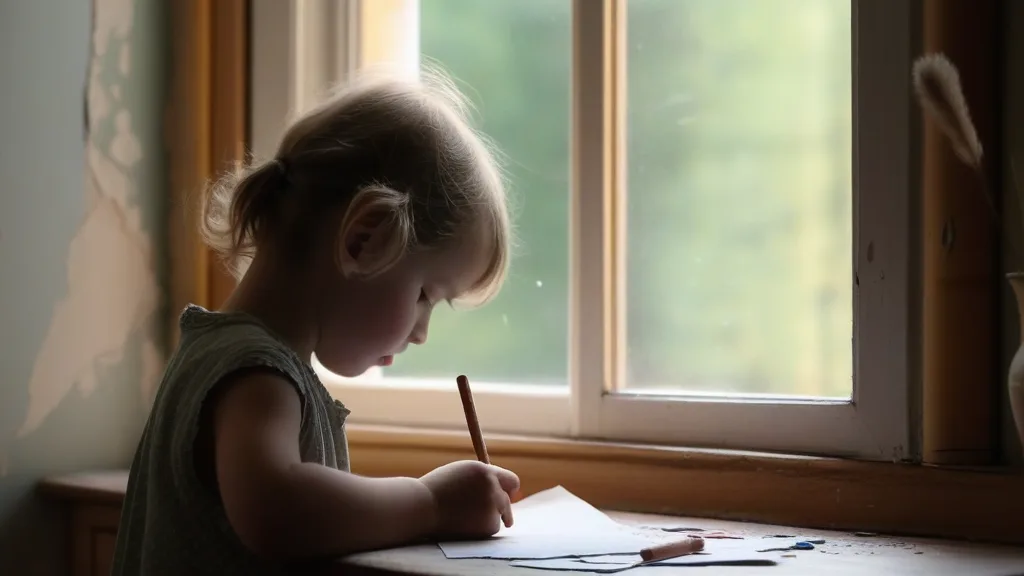
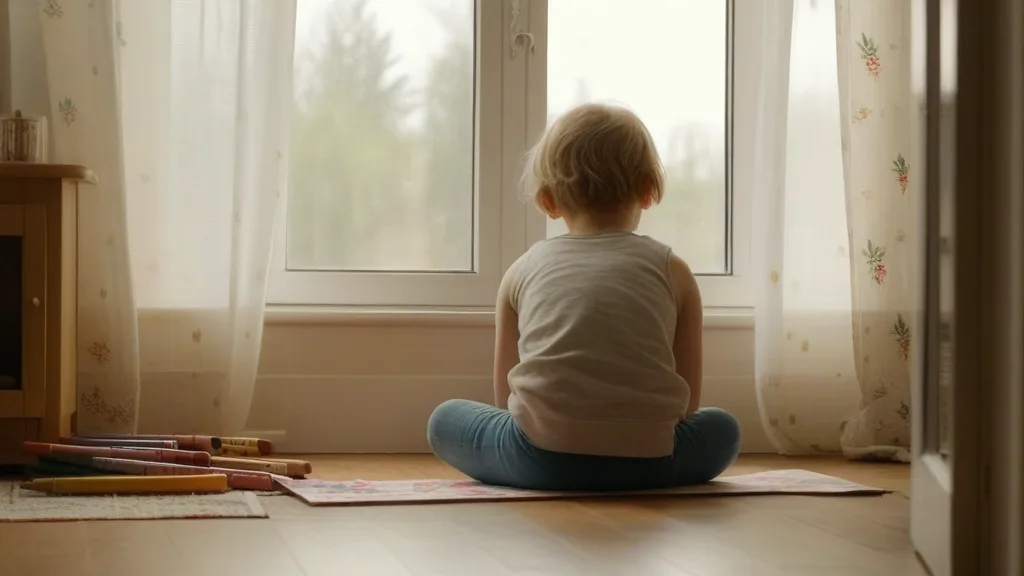
Your child is standing in the middle of a room full of blocks, dolls, and games and says ‘I’m bored,’ as if none of it exists. You reach for another idea on reflex — ‘how about playing store?’, ‘watch a show’, ‘come, let me show you something’ — and ten minutes later you hear the exact same sentence. Before you decide something’s wrong with the number of toys, or with your child, it’s worth understanding what’s actually happening in that moment — because it isn’t a problem another toy will fix.
What boredom in children actually is, and why it isn’t a problem to solve
Boredom between ages 4 and 9 is most often a transitional signal — the moment when one activity has ended and the child’s brain hasn’t yet generated the next one. It’s an unpleasant feeling, but unpleasant doesn’t mean harmful. In both adults and children, boredom serves a similar function: it pushes toward seeking a new stimulus, activates imagination, and — as research on creativity shows — often precedes ideas that would never have surfaced during a tightly scheduled day.
So the problem isn’t the boredom itself — it’s what happens right after it. If every time a child says ‘I’m bored,’ an adult immediately fills that gap with a suggestion, the child never reaches the point of having to invent something on their own. Instead they learn something else: that boredom is a signal to call the parent, not to look inward.
Why the parent-as-entertainer role hurts independence, even with good intentions
It’s very easy to slip into the entertainer role — the person who answers every sigh of ‘I’m bored’ with another suggestion, so the child doesn’t suffer even a moment. That comes from care, not from a parenting mistake. But every immediate intervention like that is one less chance for the child’s brain to practice generating its own ideas.
Children whose time is tightly scheduled (extracurriculars, screens, a parent always ready with a suggestion) statistically have fewer opportunities for self-initiated play — and it’s exactly in that kind of play, not in play organized by an adult, that a child practices decision-making, tolerating uncertainty, and coping without a ready-made plan. That doesn’t mean extracurriculars are bad — it means it’s worth leaving room for stretches where nobody suggests anything.
What to say when your child says ‘I’m bored’
The goal of your first response isn’t to suggest an activity — it’s to give your child a moment to try on their own first. Only if that genuinely doesn’t work is it worth gently helping, without handing over a ready-made solution.
- Instead of: “How about you play…” (a ready-made idea right away) → Say: “Boredom feels uncomfortable, but it’s a good sign — your brain is about to come up with something.”
- Instead of reaching for a screen as an instant rescue → Say: “I hear that nothing’s pulling you in right now. Let’s wait a bit and see what comes to mind.”
- When your child is genuinely stuck after a few minutes → Ask an open question, not a suggestion: “What’s in that box of blocks you haven’t opened in a while?” or “If you could invent any game right now, what would it be?”
- When your child protests that a self-generated idea ‘sounds boring’ → Say: “It doesn’t have to be amazing. Try it for five minutes and see if that changes.”
Tone matters here: a calm, curious question works better than a list of ready-made solutions delivered with impatience.
Small steps that build independent play over time
Independent play is a skill you build in small steps, not with a single conversation. Three things help the most over the long run.
Leave a regular window with no plan. Even 20-30 minutes a day with no suggested activity, no screen, and no extracurriculars gives your child a repeated chance to practice initiative. The less often someone fills that gap for them, the sooner they stop waiting for it.
Stay nearby instead of joining in with your own plan. If your child eventually starts something, it’s worth being close, but not taking over with ‘how about we also add this’ — that takes away the child’s sense that the idea was theirs.
Name their agency out loud when it shows up. “You came up with that game yourself — it was great watching you figure it out” reinforces exactly the mechanism you want to build: trust in their own idea, not in a ready-made adult suggestion.
It’s also worth remembering that boredom and screens are a related but separate topic worth its own conversation — we write more about how early screen time affects a child’s ability to occupy themselves independently in our article on screens in early childhood.
Sources
- Gray, P. (2011). “The Decline of Play and the Rise of Psychopathology in Children and Adolescents.” American Journal of Play, 3(4), 443–463. A study linking the decline of free, child-initiated play to difficulties with independence and tolerating uncertainty.
- Mann, S., & Cadman, R. (2014). “Does Being Bored Make Us More Creative?” Creativity Research Journal, 26(2), 165–173. A study showing that boredom preceding a task increases subsequent creativity — boredom as a stage, not an obstacle.
Your child, who says “I’m bored” in a room full of toys, doesn’t have a problem with the number of things to do — they’re still learning to trust their own idea. At Dzieckologia we write about school-age emotions without judgment and without one-size-fits-all fixes. Check out the School-Age Emotions (4-10) pillar for more concrete situations from this age.
Author
Dzieckologia Team
Tags:
Like this topic?
📖 Browse all "schoolage" articles